

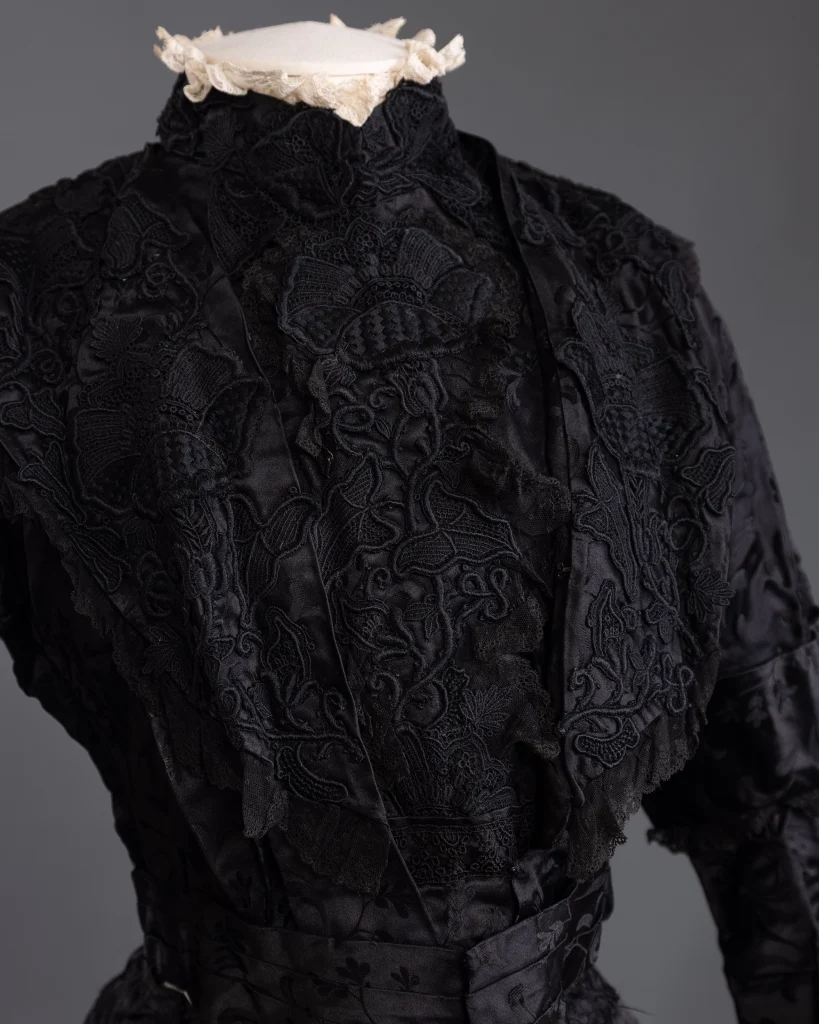


Two-piece mourning dress, 1880-1910
Pengegon House, Camborne
Two-piece mourning dress in black silk brocade and heavy lace appliqué decoration. Machine and hand sewn. Bodice is fitted and boned, with long, narrow sleeves with band and lace at elbow, and a high collar with cream lace frill. Skirt has black silk lining, pleated at the back. A ‘dorothy pocket’ hangs from a silk tape. This dress shows little to no signs of wear.
Bodice length 460mm.
Skirt length 1120mm.
From a collection of clothing belonging to the Vivian family of Pengegon House, Camborne in the late 19th – early 20th century. This dress incorporates style elements of the turn-of-the century.
Black has been associated with ideas about death and the unknown for hundreds of years or more. It is used as a symbol of darkness, the supernatural, deep sleep, loss, power and mystery – all connected to death.
Elizabethan funerals were huge affairs for nobility. They were public affairs, where masses of black-clad aristocrats and royals could flaunt their wealth. Like purples and reds, black was expensive to produce and became a shade for the very upper classes. Fines could be issued for wearing it outside of the strict social rules placed upon dress. For the lower classes, a black pin or band was acceptable.
Black for mourning costume was also centred in superstitious and religious ideas. It was a sign of respect and remembrance for the dead, but also thought to ward off Death himself. Formal mourning had become a social convention by the 1840s.
Mourning most heavily affected women, perhaps to help ward off new freedoms afforded by a rapidly changing world. Mourning clothing was a form of social signalling, and a widowed woman was expected to grieve for the longest. This also prevented them from openly forming new relationships, binding her to her deceased husband after his death. Meanwhile, a grieving man could acceptably remarry after only a few months.
In the late 1800s, however, black was also a very popular choice for every day wear, and was even chosen for wedding dresses. It was used to accent brighter colours or as evening wear to denote elegance or mystery. In the costume collection here, there are green, blue, red and even black wedding dresses from the Victorian era.
To the Victorians, to die was not a tragedy. However, to die and not be mourned was a deep fear. Mortality rates were higher, half of children did not live to adulthood and the life expectancy was 50. Mourners would often spend so much money on mourning clothes and burial etiquette that they would be left with no financial stability. After prince Albert’s death in 1861 Queen Victoria went into a deep state of mourning that continued for the rest of her life. She became a role model of ‘The Mourning Widow’.
Materials
Associations
Silk brocade, lace
Pengegon House was converted to a nursing home before being demolished during the mid-1900s.